
Outdoor Payment Kiosk Machines: Key Features, Applications, and Benefits for Smart Cities
Mar 15, 2026As urban environments continue to evolve toward digital infrastructure and smart city ecosystems, governments and service providers are increasingly adopting automated technologies to improve efficiency and convenience. Among these technologies, outdoor payment kiosk machines have emerged as an essential solution for delivering reliable self-service payment options in public environments.
Outdoor payment kiosks are designed to operate in unattended outdoor locations, allowing users to complete transactions quickly and securely without requiring assistance from staff. These machines are commonly installed in parking facilities, transportation hubs, toll stations, and public service areas, where they enable citizens and visitors to pay fees, purchase tickets, and access services 24 hours a day.
Compared with traditional manual payment systems, outdoor kiosks significantly improve operational efficiency while reducing labor costs. At the same time, they enhance the user experience by offering fast, convenient, and secure payment methods.
In this article, we will explore what outdoor payment kiosk machines are, their key technical features, common applications, and why they are becoming a critical component of modern smart city infrastructure.
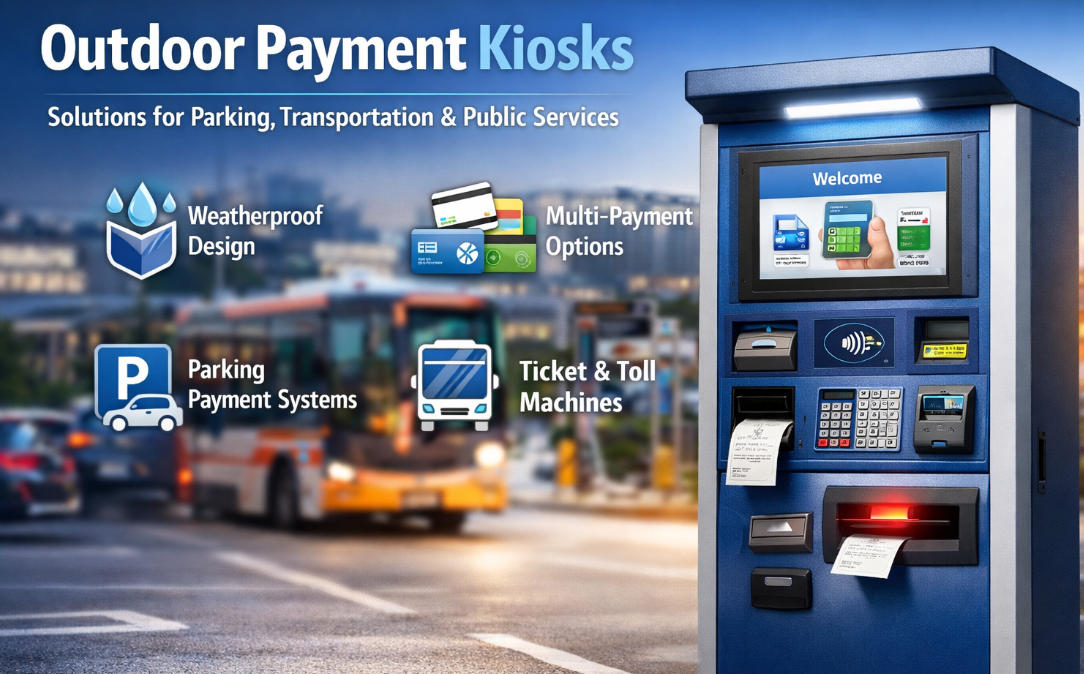
An outdoor payment kiosk machine is a specialized self-service terminal designed for use in public outdoor environments. These kiosks allow users to complete various financial transactions independently, including paying parking fees, purchasing transport tickets, or making government service payments.
Unlike indoor kiosks, outdoor payment terminals must operate reliably in harsh environmental conditions. They are engineered with industrial-grade hardware, protective enclosures, and environmental resistance features to ensure continuous operation in public spaces.
Outdoor kiosks are specifically built to withstand a range of environmental challenges, including:
Rain, snow, and humidity exposure
Dust, sand, and airborne debris
Extreme temperatures, both hot and cold
Direct sunlight and ultraviolet radiation
Potential vandalism or physical tampering
Because of these challenges, outdoor kiosks are typically constructed with weatherproof cabinets, reinforced materials, and advanced security mechanisms to protect internal electronics and payment modules.
Modern outdoor payment kiosks also integrate multiple payment technologies, network connectivity, and remote management systems, allowing operators to monitor devices and process transactions in real time.
Outdoor payment kiosks incorporate a combination of durable hardware, secure payment technologies, and user-friendly interfaces. Below are the most important features that define high-quality outdoor payment kiosk machines.
One of the most important characteristics of an outdoor kiosk is its ability to withstand harsh weather conditions.
Most outdoor payment kiosks feature IP65 or IP66-rated cabinets, which provide protection against both dust and water intrusion. These sealed enclosures prevent environmental damage to internal components such as payment modules, processors, and displays.
In addition to waterproofing, outdoor kiosks are typically constructed using industrial-grade steel or aluminum, which offers high durability and corrosion resistance. Protective coatings and anti-rust treatments are often applied to extend the lifespan of the equipment.
Many outdoor kiosks also incorporate temperature control systems, including internal heaters, cooling fans, or air conditioning units, to maintain stable operation in extreme climates.
Outdoor environments present unique visibility challenges, especially when kiosks are exposed to direct sunlight. To ensure users can clearly see the interface, outdoor payment kiosks utilize high-brightness LCD displays, typically ranging from 1000 to 2500 nits.
These displays are specifically designed for outdoor readability and often include additional technologies such as:
Anti-glare glass
Optical bonding for improved contrast
Automatic brightness adjustment based on ambient light
UV-resistant protective layers
By combining these technologies, outdoor kiosks provide clear and readable screens even under intense sunlight.
The user interface is another critical element of outdoor payment kiosks. Most modern kiosks are equipped with projected capacitive (PCAP) touchscreens, which offer accurate, responsive, and durable touch performance.
Compared with older resistive touch screens, PCAP technology supports:
Multi-touch interaction
Higher durability
Better visual clarity
Faster response times
To further enhance durability, outdoor kiosk screens are usually protected by tempered or laminated safety glass, which resists scratches, impacts, and vandalism.
Some systems also support glove-friendly touch technology, allowing users to interact with the screen during cold weather conditions.
To meet diverse user preferences and modern payment standards, outdoor payment kiosks support multiple payment options.
Typical payment modules include:
Contactless NFC payments using smartphones or smart cards
EMV chip and PIN card readers
Magnetic stripe card readers
QR code scanning for mobile payments
Cash acceptors and bill recyclers (optional)
By supporting a wide range of payment methods, outdoor kiosks ensure accessibility for both digital-first users and traditional cash users.
Secure payment processing is typically achieved through compliance with industry standards such as PCI-DSS certification and encrypted communication protocols.
Many outdoor payment kiosks include thermal receipt printers that provide users with transaction confirmations, parking tickets, or transport receipts.
These printers are designed for high reliability and are often protected within sealed compartments to prevent damage from moisture or dust.
In addition to traditional receipts, some kiosks also support digital receipt options, such as sending confirmation via QR code or mobile application.
Because outdoor kiosks operate in public and often unattended locations, security is a critical consideration.
Manufacturers incorporate several anti-vandalism features, including:
Reinforced steel enclosures
Tamper-resistant locks
Security cameras or monitoring systems
Shock-resistant internal component mounting
Alarm sensors for unauthorized access
These features help protect both the physical machine and sensitive financial data.
Modern outdoor kiosks are connected to centralized management systems through various network technologies, including:
Ethernet connections
4G or 5G cellular networks
Wi-Fi connectivity
Remote monitoring platforms allow operators to track kiosk performance, monitor transactions, and perform software updates without visiting the site.
This capability significantly reduces maintenance costs and improves system reliability.
Outdoor payment kiosks are widely used across various industries and public services. Their ability to provide automated, 24/7 self-service transactions makes them particularly valuable in high-traffic environments.
Below are some of the most common use cases.
One of the most widespread applications of outdoor payment kiosks is automated parking management.
Parking kiosks allow drivers to pay parking fees directly at the machine using various payment methods. These systems can integrate with:
License plate recognition systems
Mobile parking applications
Parking enforcement software
By automating the payment process, parking kiosks reduce congestion and eliminate the need for manual payment booths.
Outdoor payment kiosks are frequently deployed in bus stations, subway systems, and train platforms.
These kiosks enable passengers to purchase tickets, reload transit cards, or check travel information without waiting in line at staffed counters.
Transportation authorities benefit from reduced staffing requirements and improved service availability.
Highway and bridge operators increasingly rely on outdoor payment kiosks to collect toll fees efficiently.
Drivers can use these kiosks to pay tolls using cards, mobile payments, or cash. The kiosks can also integrate with electronic toll collection systems, improving traffic flow and reducing congestion.
In some regions, outdoor kiosks allow residents to pay utility bills such as electricity, water, and gas. These kiosks are often installed in convenient public locations such as shopping areas, community centers, or government offices.
They provide an alternative payment channel for individuals who prefer in-person transactions rather than online payments.
Many governments are adopting self-service kiosk systems to improve access to public services.
Outdoor payment kiosks can support services such as:
Tax payments
Permit or license fees
Municipal service charges
Public transportation card reloading
These systems reduce administrative workload while providing citizens with convenient 24-hour access to services.
The growing adoption of outdoor payment kiosks is driven by several key advantages.
Unlike traditional service counters that operate during limited hours, outdoor kiosks provide continuous service access, allowing users to complete transactions at any time.
Automation reduces the need for manual staff involvement, enabling organizations to lower operating costs while handling higher transaction volumes.
Self-service kiosks allow users to complete payments quickly, reducing queues and improving overall service speed.
By supporting multiple payment options and intuitive touchscreen interfaces, outdoor kiosks provide a simple and accessible payment experience for users of all ages.
Organizations can easily expand kiosk networks by installing additional units in high-demand areas, making outdoor kiosks a scalable solution for urban service delivery.
The rapid growth of smart city initiatives worldwide is accelerating the adoption of outdoor payment kiosks.
Smart cities aim to use digital technologies to improve urban management, optimize public services, and enhance the quality of life for residents.
Outdoor payment kiosks play a crucial role in this transformation by enabling:
Automated public service delivery
Cashless and contactless payment systems
Data-driven service management
Reduced administrative workload
By integrating with other smart city systems such as transportation networks, parking management platforms, and digital identity services, outdoor kiosks become a key part of the connected urban ecosystem.
As technology continues to evolve, outdoor payment kiosks are expected to incorporate several advanced features.
Emerging trends include:
AI-powered user interfaces for improved usability
Biometric authentication for secure identification
Cloud-based management systems for large kiosk networks
Integration with mobile applications and digital wallets
Energy-efficient designs using solar power
These innovations will further enhance the functionality and sustainability of outdoor kiosk systems.
Outdoor payment kiosk machines have become an essential component of modern urban infrastructure. By combining durable hardware, advanced payment technologies, and intuitive user interfaces, these kiosks provide reliable self-service solutions for a wide range of public services.
From parking management and transportation ticketing to government services and utility payments, outdoor kiosks enable organizations to deliver convenient, secure, and efficient transaction experiences.
As cities continue to adopt smart technologies and digital services, the demand for high-performance outdoor payment kiosks will continue to grow. Organizations that invest in these systems can improve service accessibility, reduce operational costs, and support the development of smarter, more connected urban environments.
Tel / Whatsapp : +86 -15999943922
Correo electrónico : nikki@aonpostech.com


© 2026 Tecnología Co., Ltd de Shenzhen Aonpos .Reservados todos los derechos